
How AI Will Transform and Revolutionize Your Job
Since the rise of AI and the introduction of ChatGPT, many tech and non-tech individuals have been extremely worried and concerned about whether AI will

Since the rise of AI and the introduction of ChatGPT, many tech and non-tech individuals have been extremely worried and concerned about whether AI will or will not take over their jobs. This is a continuous discussion, and even after I share my perspective on this matter, we still cannot conclude until we see for ourselves, if it is the case or not. On the other hand, the best sets of people who can give answers to these questions are people who make use of these AI tools.
One thing that is true so far is that as time goes on, all AI tools will continue to learn and improve day by day till they become intelligent enough to do some of our jobs well. And their intelligence is solely dependent on the kind of information we give these tools. meaning our usage will determine the future of the tools. This is to tell you that even before now, employees have been getting laid off from their place of work, so it’s not a thing.
So far in 2024, several companies announced layoffs as they adapted to new technologies and market conditions. For instance, Google laid off employees as part of a broader restructuring effort to streamline operations and focus on AI-driven products. The company cited the need to realign resources towards areas with the highest growth potential, such as artificial intelligence and cloud computing.
Similarly, Meta (formerly Facebook) announced significant job cuts, which they attributed to the ongoing shift towards more automated processes and the need to prioritize projects related to the metaverse. This move was seen as a way to reduce costs and increase efficiency in response to evolving technological trends.
Amazon also faced layoffs, primarily in its retail and logistics divisions. The company pointed to advancements in automation and AI, which reduced the need for manual labour in warehouses and other operations. This was part of Amazon’s ongoing effort to optimize its workforce and adapt to the increasing role of technology in its business model.
These examples highlight how technological advancements, particularly in AI, can lead to shifts in the job market, often resulting in layoffs as companies restructure to adapt to new realities.
Now, imagine you happen to be one of the layoffs, but you seem to be familiar with the new technologies. Trust me, you will get a promotion or join another team. People who have been working in tech understand that the advancement in the tech sector changes by the day and we all need to adapt to these changes. As a javascript developer, 10 out of 100 projects I work on in a year will request some new technologies; AI, Blockchain, etc. This constant evolution means that staying up-to-date with the latest tools and trends not only makes you more valuable in your current role but also opens up new opportunities in emerging fields. It’s a reminder that adaptability and continuous learning are key in the ever-changing landscape of technology.
Advancement in technology affects the specialist more than the generalist. a specialist focuses on one specialised area, of course, they become extremely good at what they do, but some of them are not open to learning new things. but a generalist can pick up something new each day and improve through all.
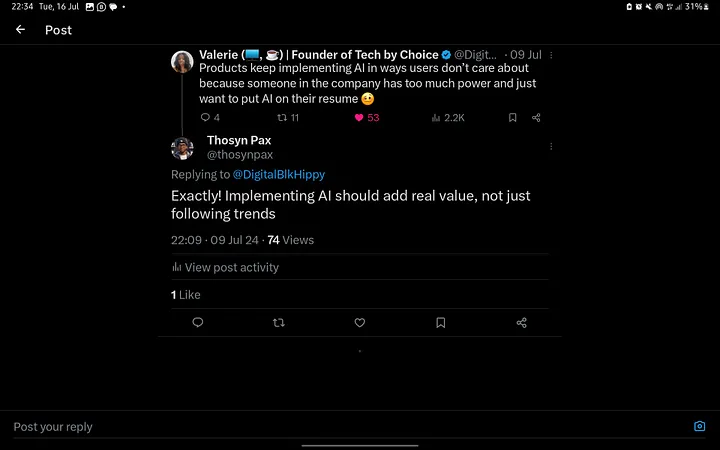
Adding Value vs. Following Trends
I chose this first screenshot on purpose because I think we still need to talk about this issue. I’d like to hear your thoughts on it as well, so please don’t hesitate to share. Thanks!
Valerie, the founder of Tech by Choice, made an important point about how AI is being used. She suggests that some companies are pushing for AI not because it solves real problems or makes things better for users, but just because someone in charge wants to say they did it. This shows a worrying trend where AI is seen as just a buzzword or a way to look good, rather than a tool for real improvement.
In response, I stressed that AI should be used thoughtfully. Adding AI to a business should be about bringing real benefits, not just following the latest trend. Companies need to understand how AI can truly improve their products, services, or operations in meaningful ways.
This discussion raises some key points for businesses thinking about using AI. They should carefully consider where AI can solve problems or create new opportunities, making sure it’s not just a shiny new addition. As Valerie points out, AI that users “don’t care about” won’t be effective. Good AI integration should focus on making things better for users or solving their issues.
There’s a risk that companies might use AI just to look good or to boost the resumes of executives. This can lead to wasted resources and missed chances for real innovation. To avoid this, businesses should set clear goals for their AI projects, focusing on real benefits like better efficiency, improved decision-making, or happier customers.
Although it wasn’t directly mentioned in the conversation, the ethical aspects of using AI are also important. Companies should make sure their AI use is ethical and doesn’t harm users or employees. This conversation highlights the need for careful thinking in the tech industry about how and why we use AI.
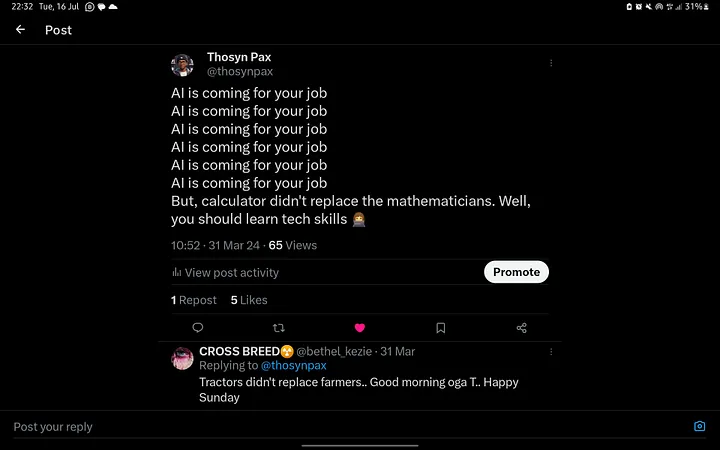
AI is coming for your job
Is AI here for our jobs? Well, AI is here to stay, no doubt. This doesn’t mean that your skills are redundant. Several technologies have been introduced over the decades, and new, improved technologies will continue to emerge. And yes, there will still be layoffs.
However, just as the calculator didn’t replace mathematicians, AI won’t replace skilled professionals; instead, it will transform their roles. Calculators enhanced the work of mathematicians by automating routine calculations, allowing them to focus on more complex and creative problem-solving. Upon writing this article, I used Grammarly to make corrections severally before publishing. Grammarly is one amazing tool for this kind of usage. Meaning, that if I am to proofread my book, and decide to hire a freelance editor, it means I will be doing it so I can create time for others. Now, there are possibilities that this editor will make use of AI to proofread and I probably won’t know. Well, it won’t matter since the job is done.
Similarly, AI is set to handle repetitive and data-intensive tasks, enabling professionals to engage in higher-level thinking and innovation. The key is to see AI as a tool that complements human abilities rather than as a replacement. By staying adaptable and continuously upgrading your skills, you can leverage AI to enhance your work rather than fear it as a threat.
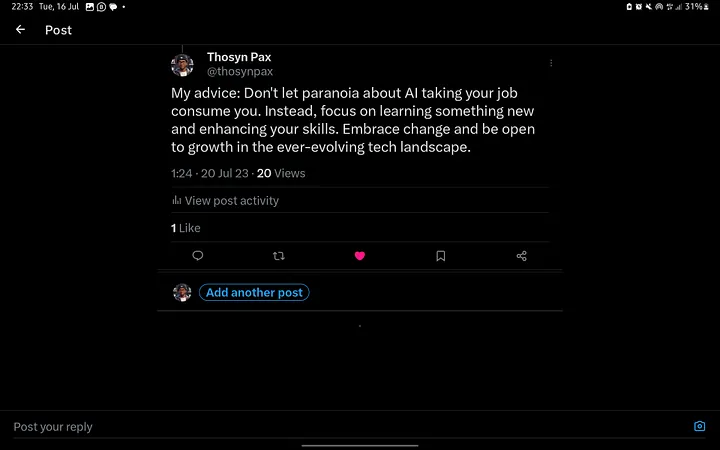
Don’t Fear AI, Embrace Growth
Don’t let paranoia about AI taking your job consume you. Instead, focus on learning something new and enhancing your skills. Embrace change and be open to growth in the ever-evolving tech landscape.
AI is a big part of us already. It’s natural to feel worried about how these advancements might affect your job. However, fear won’t help you move forward. What will help is a positive attitude towards learning and self-improvement.
To thrive in this new tech landscape, continuously update your skills. Take courses, attend workshops, and stay curious about new technologies. Twitter (X) is a great place to get familiar with new technologies and to know what people are working on. Also, Reddit, and Quora. By doing so, you’ll not only keep your job secure but also open up new opportunities for growth and advancement.
Remember, change is inevitable. The best way to deal with it is to embrace it and use it to your advantage. Keep learning, keep growing, and you’ll find yourself well-equipped to navigate the future of work with confidence.
Written by
PASTE Editorial